Chemotherapy is a major form of treatment for leukemia. It uses chemicals to kill leukemic cells, and depending on the type of leukemia a person has, he or she will receive either a single drug or a combination of drugs. The drugs can be injected directly into the veins, or they can come in pill form.
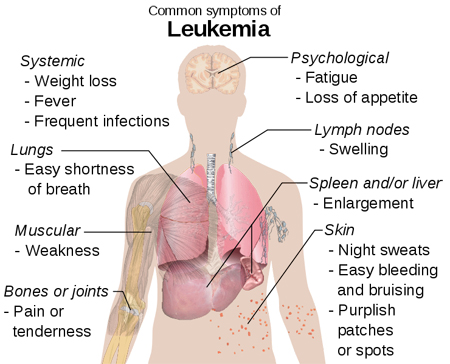
Although Leukemia symptoms vary depending on the type of leukemia a person has, there are several common symptoms of leukemia. These symptoms include:
Fever or chills
Persistent fatigue or weakness
Getting infections frequently
Weight loss
Swollen lymph nodes
Enlarged liver or spleen
Bleeding or bruising easily
Small red spots on your skin, called petechiae
Profuse sweating, especially at night
Bone pain or tenderness
Leukemia symptoms are often overlooked because of their resemblance to symptoms from the flu or other common illnesses, but a doctors appointment is needed if a person experiences these symptoms persistently.
There are multiple different types of leukemia, but the four most common are Acute Myeloid Leukemia (AML), Acute Lymphoblastic Leukemia (ALL), Chronic Myeloid Leukemia (CML), and Chronic Lymphoblastic Leukemia (CLL).
Acute Myeloid Leukemia (AML)
Many patients with AML need treatment as soon as possible and in some cases AML can be cured with regular therapies. This type of leukemia mostly affects cells that aren't developed, so that they are unable to perform their functions; a reason why treatment is needed as soon as possible.
Chronic Myeloid Leukemia (CML)
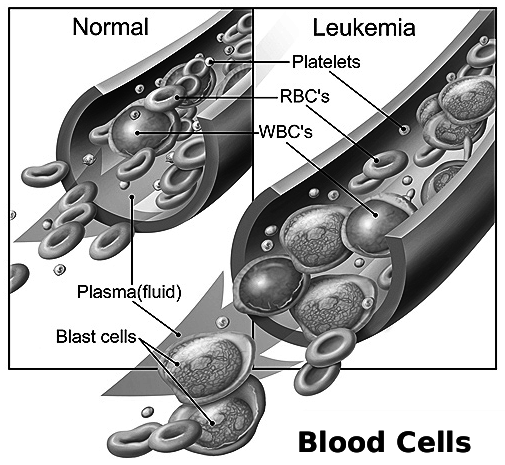
Many patients with CML are treated with daily oral drug therapy. This type of leukemia has three different phases, and it is normally diagnosed in its early stages when symptoms aren't as noticeable. In the first stage, the chronic stage, white blood cells can still fight infection and are treated with long-tern drug therapy. Very few individuals advance to the next phase, the accelerated phase. Within this phase, your blood may have a lower-than-normal number of red blood cells, along with a lower number of platelets. You may also experience a swollen spleen. In the next phase, the blast crises phase, you have a high number of blast cells (infected cells) in your bone marrow and blood. You may experience infection, bleeding, tiredness, stomach pain, shortness of breath, or bone pain. Once a patient has reached this phase it is life threatening.
Acute Lymphoblastic Leukemia (ALL)
This type of leukemia is the most common type of cancer in children ages one to seven, and it affects the blood cells and the immune system. There are subtypes of ALL and the treatment a person receives depends on the subtype that he or she has. It spreads rapidly without treatment, so it is important to start treatment as soon as possible after diagnosis; most children with the disease are curable with treatment.
Chronic Lymphoblastic Leukemia (CLL)
CLL is the most common type of leukemia in adults, but in some people the disease spreads faster while in others it spreads slower. In people with slow-spreading CLL, the best treatment may be watchful waiting. Many patients with this type of leukemia live good-quality lives for a long time with medical treatment.
Leukemia is a cancer that affects blood and bone marrow, and it is caused by the mutation in the DNA of blood cells. These mutations can occur naturally or be influenced by outside factors.
When white blood cells loose a piece of their DNA or their DNA is damaged a person will start to develop Leukemia. As with all cancer cells, these cells have developed a mutation so that they don’t need to go through the checkpoints in mitosis, a type of cell division. The leukemic cells are able to divided over and over again, and soon it creates an immature form that will never fully mature. However, unlike normal blood cells, these cancerous cells will not die but continue to replicate until the ratio of mutated cells is larger than the normal cells.
Another way the mutation of a white blood cell may occur is if one part of a chromosome detaches and attaches itself to another chromosome. This is called translocation and it disrupts the normal sequence of DNA along with adding the possibility of tumor growth. Radiation can cause Leukemia as well; damaging or destroying cells, and causing translocation.
The following is an informational video about Leukemia:



 More Information:

 The Leukemia and Lymphoma Society